

By: Jacob Levin
A computer doesn’t function without some sort of operating system. Without a basic system to instruct components how to interact together, the computer could never turn on; the power button couldn’t initialize startup because there’d be no startup functions. So too with the human mind: without a basic system of thought, there could be no thought whatsoever. This is what Kant referred to as a priori. All those abilities babies seem to have from birth, like the ability to identify an object as an object, are part of a priori.
There’s another level of thought that is adopted very early on. It seems to come in at the same time as language. This is because this is the level that connects thoughts together. Once one has a thought– something simple, like table when one sees a table–, one begins to feel some way about the table. This is encoded into language. I see the table. That’s more complex. It requires an understanding of the concept of sight. (What is sight? Does one affect the object seen when one sees it? Newtonian: no; Quantum: yes.)
Also necessary is the first person pronoun: I. Who am I? Am I the table? One has to be able to identify oneself as separate to other things, and other things as separate to oneself. (Narcissists have a very difficult time with the latter clause.)
The questions rhetorically asked in the last two paragraphs are actually much more complicated than at first glance. I tried to hint to that fact through the parentheses. In Medieval Europe, it was well-received knowledge that the world was lit up by one’s eyes. Sight created the image. Then, once they got a hold of Aristotle from Muslim Spain, they discovered that light existed on its own, and that light bounces off an object, enters the eye, and thus forms the image. The world exists as other to you, independent of you: Sight is the process by which we are subjugated to objective reality.
That might seem correct to you, the reader. It is common sense today in European-dominated cultures that there is an objective reality that we discover by observing it. In the early 20th century, that was challenged to such a degree that one could return to the old, medieval understanding. According to quantum mechanics, the act of observation affects reality. By seeing, the image is created. There would be a different image if it hadn’t been seen.
All this is to demonstrate two fundamental points: (1) A system of serious, legitimate, philosophical answers is a prerequisite for forming second-level thoughts, such as simple sentences; and (2) There is more than one valid system. We know there is more than one valid system, since you, the reader, are simultaneously expected to believe quantum mechanics– the height of European Science– and the “common sense” that Science endorsed for hundreds of years, and still endorses at certain scales. The image is created, but the image is independent. These are two systems, equally valid.
Additionally, when one wishes to change the way they think– the way they form sentences– they must adopt some other philosophical answer first, and only then reject the old answer. If it were the other way around, they’d be left without a sentence to accept the new answer. Momentarily, they hold two answers to be true. This is cognitive dissonance, which can cause someone to lash out or act irresponsibly if they can’t reject the old answer, and that moment of having two answers lasts too long.
How does the baby adopt a philosophical system so young? The same way they adopt language: observation and imitation (with an a priori framework to allow for development). The baby sees everyone speaking and acting in accordance with their shared philosophical system, and subsequently imitates, adopting that very same system. The system is called civilization.
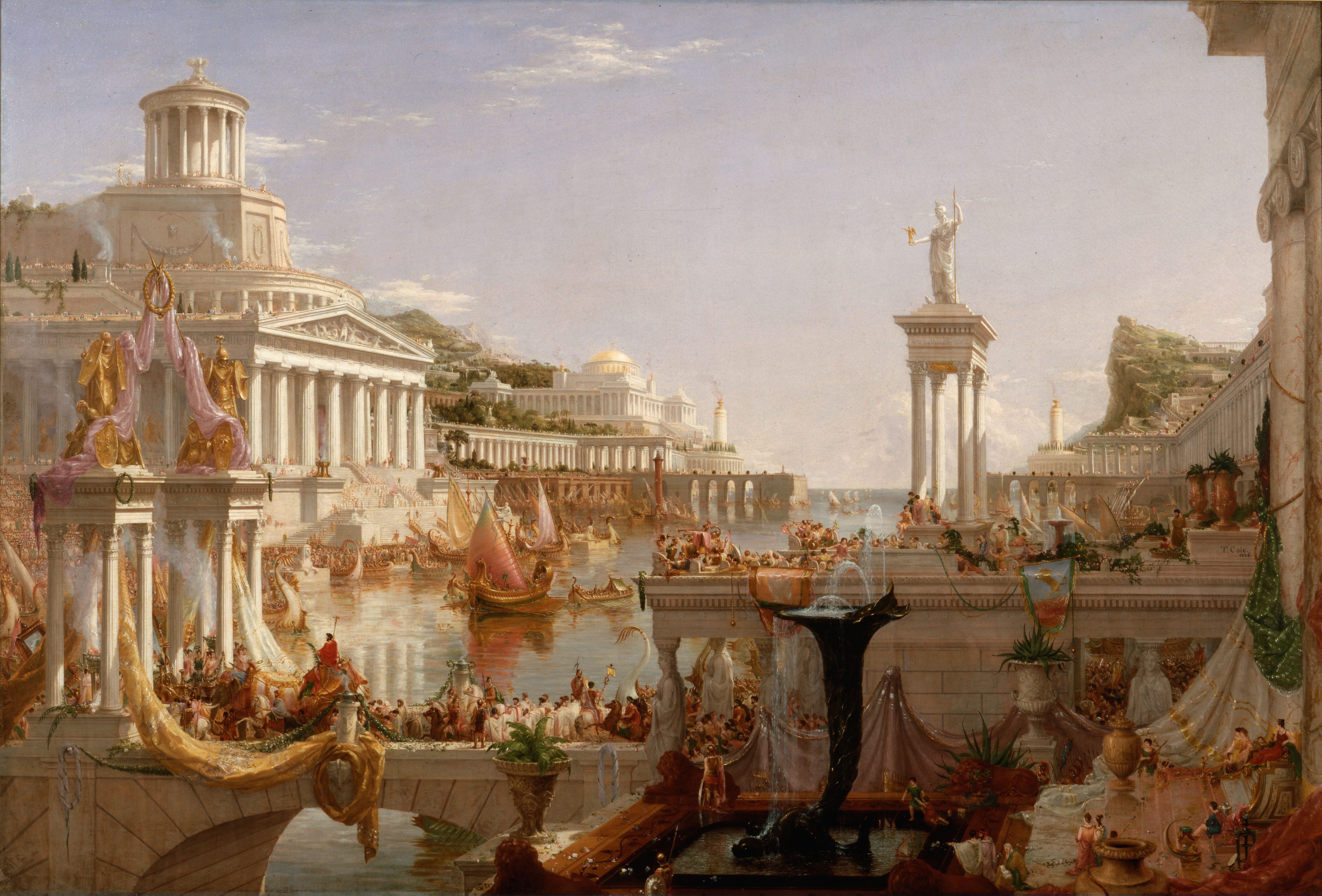
One cannot be outside civilization. It is not possible, just as it is impossible to form simple sentences without language. However, just as one can learn a new language, one can “emigrate” from one civilization to another. There is more than one civilization. Rome, China, Greece, India, Arabia, Mesopotamia, Egypt…
Egypt.
Israel left Egypt, but where did they go? They went to Israel. The Exodus was not just a physical exit from the borders of a state, but a spiritual exit from the philosophy of a civilization. Through the Ten Plagues, the journey to Sinai, the Revelation at Sinai, and the journeys through the desert, God bestows upon and teaches to the nation of the Children of Israel, the divine civilization.