

From Hadesh Vol. 2, Iss. 1 - Freedom
By: Jacob Levin
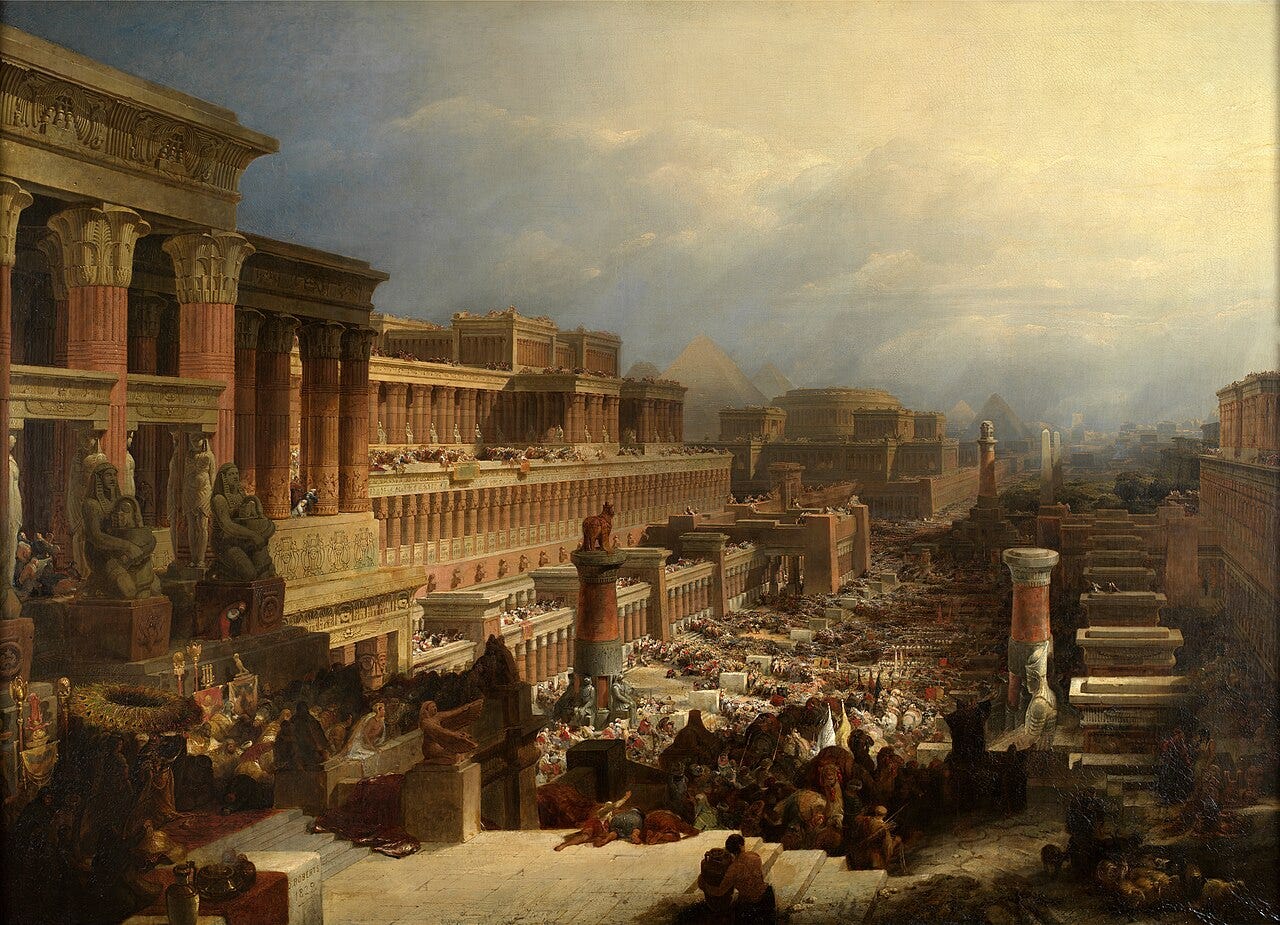
Every year at the Seder, we confidently declare that had God not extricated us from Egypt, then we, our children, and our children’s children would have remained slaves to Pharaoh in Egypt. How many of us have truly believed that? That Egypt would have continued indefinitely, and that no other imperial power would have come to dominate the region?
Many commentators have attempted to explain this. Their answers fall into three main categories: historical, mental, and spiritual.
First, historical. Some have explained that every other empire expelled us, but Egypt tried to retain us and make us a slave race.1 This does not seem true; Persia attempted to exterminate us, not export us. More recently, the Papal States, among other European powers, kept us in ghettos, barring us from leaving. Famously, the USSR did not want its Jews to leave.
Another historical answer is more theological: the statement means that without God’s promise to Abraham, we would have become Egyptian completely.2 Since we would not have been distinct enough to separate, we would have remained there forever as slaves to Pharaoh (like all other Egyptians). In what way would we become Egyptian?
Second, the mental answer is that the past influences the future. Even though we might have escaped the physical burdens of Egypt, we never would have escaped the trauma of slavery, and it would have been baked into our ethnic identity.3 Some commentators went further, saying we never would have escaped due to that slave mindset.4 Does this require a Pharaoh, or could we think like Egyptian slaves even outside of Egypt?
Third, there are two spiritual answers. One is that the Exodus is like a birth, and the key of childbirth stays in God’s hands. That is, only God could have actualized our potential to be a nation.5 What does it mean to be a nation?
The other spiritual answer is that if God had not taken us out, we would have been consumed by the impurities of Egypt, from which we could never have escaped.6 What is impurity?
When one answers the lingering questions, I believe all the answers reveal themselves to be the same answer. To be an Egyptian, rather than an Israelite, one must think like an Egyptian. One must have an Egyptian mindset of being a slave to Pharaoh. The impurities of Egypt are those Egyptian thought processes, and the more we think like Egyptians, the more we become Egyptian. Egypt itself may not have endured, but without God’s intervention, we never would have left Egyptian civilization and started thinking like Israelites.
The same is true today. The more we think like Americans, or like Westerners, the more we are in Western civilization. The more we think like Arabs, the more we are in Arab civilization. In each case, we are less in Israelite civilization. So how do Israelites think?
When we left Egypt, we also left their mindset– as much as we could, anyway. The subsequent passages in the Torah tell us how we should think instead. Immediately upon leaving Egypt, Moses leads the Israelites in the spontaneous, prophetic recitation of poetry. This is an aspect of civilization: Literature; in this case, poetry. The Torah then tells us about Miriam’s Music– another aspect.
They came to Mara, where Moses was given “law, and there he tested it,”– Science.7 After that, they encamped in Elim by twelve springs and seventy palms, parallelling the twelve tribes and seventy elders, illustrating Government and Law.
After the promise of food falling from the sky, Aaron speaks to the entire camp, and God’s glory was seen in the clouds, possibly referring to Art. The Israelites receive the concept of the Sabbath, too, introducing Israelite Time. When the heavenly bread descends, the Israelites coin a new word, demonstrating their mastery over Language. At the end of that section, we are told about Measurement.
From there, the Israelites travel to Rephidim, where Moses brings water from a rock, possibly indicating irrigation, and thus Agriculture. Finally, Amalek attacks. It seems we learned Martial Arts here, though perhaps we were supposed to learn something else before Amalek interrupted.
While I am not yet completely confident in this exact list, a couple of these aspects serve as good examples of civilizational differences and the meaning of leaving Egypt every year. Literature, particularly poetry, is one of the aspects I’d like to focus on. Poetry as a rule uses a higher register– a higher vocabulary, older or more obscure grammar, or a loftier tone, or all three. The reasons for this vary between civilizations.
Egyptian poetry was mainly used for praising gods and their agents or for imparting specific wisdom.8 Their poetry uses a lot of alliteration and parallelism, and it gradually builds to a climax. This may remind you of Biblical poetry, but there is at least one key difference: Israelite poetry never engages in significant narrative.9 Though no Egyptian poem before the Battle of Kadesh is strictly narrative, there is much exposition and narrative in their poems of praise and wisdom.10
Western poetry is seemingly exclusively narrative. Epic poetry tells of grand historical themes to imbue the reader with knowledge, while dramatic poetry tells of more personal stories in order to provide catharsis.11 Though Western poetry does have a greater emphasis on emotion than Egyptian poetry, it imparts emotion on the reader through a shared narrative. From a more modern perspective, poetry is meant to provide an illogical space where emotions can thrive.12
Israelite poetry strictly conveys ideas, whether wisdom (Proverbs, Job) or emotion (Psalms). Where there is a semblance of narrative, it is only described enough to convey the relevant emotion of praise (Song of the Sea, Song of Deborah, Song of Hannah).13
Government, too, is highly illustrative of the fundamental differences between civilizations. The Egyptian government was highly centralized and controlled by a strict, executive bureaucracy. The Pharaoh was at the top, and all his subjects were his slaves. To extend his reach, the Pharaoh had a vizier in charge of administration, like a chief of staff. The country was divided into 42 administrative divisions called nomes (or seplut in Egyptian), each of which had a temple that served as an administrative, economic, and religious capital. Each nome had its own governor who acted like its own Pharaoh but reported to the vizier.
The Egyptian government was predicated on the idea of absolute power in the hands of one man who doles out pieces of absolute power in small chunks so that no governor could overpower him.
Today’s Western governments vary greatly, but they all build off the Roman system. There is an aristocracy, whether hereditary or plutocratic, that makes decisions on behalf of the citizens of the state. There are popular elections where the people choose which members of the aristocracy should make those decisions. Fundamental ideas include the separation of powers, the social contract, and natural rights.
The Israelite government is composed of twelve tribes, seventy elders, and one king. Each city has its own court, whether three or twenty-three judges, who are chosen based on merit.14 Seventy of those city courts each elect a representative from among themselves to the national capital to serve as their elder. Those representatives form a body both judicial and legislative, who judge the toughest cases and make legislation as needed.15
The king exists entirely outside this system. When the elders are unable to act, the king intervenes.16 He also has other military, executive, and bureaucratic duties, like road maintenance.17 He can employ as many people as needed to carry out his duties.18
Each tribe has its own capital and courts as well.19 The tribes often administer themselves with no need for intervention from the national government. In fact, each city often governs itself with no intervention from the tribal governments. And if two Israelites can resolve their dispute without the courts, no court intervenes.20
The Israelite government promotes the authority of wise, local leaders, reserving their national leaders for real emergencies.21 It is built on wisdom, independence, and community. Towards the end of the Haggada, there is a statement: “בכל דור ודור חיב אדם לראות את עצמו כאלו הוא יצא ממצרים.” Why bother with “in each and every generation”? It is enough to say that one is obligated. Furthermore, the word “לראות” does not mean “to imagine”, but “to see”. What does it mean that they should see themselves as if they left Egypt?
Every generation of our exile, we are given the opportunity to “leave Egypt”, to abandon our host civilization and return to thinking like Israelites. Originally, that host civilization was Egypt. Then it was Mesopotamia, then Persia, then Greece, and finally Rome. Leaving Egypt means making an effort to think like an Israelite. So in every generation– whichever exile we are in– one is obligated to see themselves as if they left Egypt– to look inside themselves and “leave Egypt” in this metaphorical sense. Introspect. Question your fundamental beliefs. Wonder what a modern, forward-looking Israelite would do.
What is Israelite literature? Maybe you can write some. What is Israelite art? Maybe you can create some. And we at Hadesh would love to see it. Tag us on Twitter @hadesh_renewal or email us at editor.hadesh@gmail.com and share your ideas and creations with us. Together we can leave Egypt and enter Israel.
Barukh SheAmar, the commentary of Rav Barukh Epstein, author of the Torah Temima
Rav Yom Tov ben Avraham Isbili, the Ritva
Rav Jonathan Sacks. Also Yismah Yisrael, the commentary of Rav Yerahmiel Yisrael Danziger
Zevah Pesah, the commentary of Rav Yitzhak Abarbanel
Divrei Negidim
Marbeh Lesaper, the commentary of Rav Yedidia Weil, the son of the author of the Korban Netanel. Also, Midrash BeHiddush, the commentary of Rav Eliezer Foah, as well as Yismah Yisrael and Zevah Pesah.
For a brilliant understanding of this point, please refer to Dr. Jon Greenberg’s essay, Science, Torah, and Herbalism at the Bitter Waters of Marah, found on his website, Torah Flora.
Miriam Lichtheim, Ancient Egyptian Literature, Volume II: The New Kingdom, with a new foreword by Hans‑W. Fischer‑Elfert (Berkeley and Los Angeles: University of California Press, 2006), 6.
Robert Alter, The Art of Biblical Poetry, rev. and updated ed. (New York: Basic Books, 2011), 29–30.
See the Hymn to Shu for a clear example.
Based on Aristotle’s Poetics. Dramatic poetry is meant to allow an audience to feel acute emotions and release them, whereas lyric poetry lets a subtler emotion linger through music.
Li Ou, “Keats and Negative Capability,” in Keats and Negative Capability (London: Continuum, 2011), 1–22.
Alter, Art of Biblical Poetry, 29–30.
Mishneh Torah, Hilchot Sanhedrin 1:10, 2:1.
Mishneh Torah, Hilchot Mamrim 1:1-2.
Mishneh Torah, Hilchot Melachim 3:10.
Mishneh Torah, Hilchot Melachim 5:3.
Mishneh Torah, Hilchot Melachim 4:2-5.
Mishneh Torah, Hilchot Sanhedrin 5:1.
Mishneh Torah, Hilchot Sahnedrin 22:6.
Consider Jethro’s advice to Moses.