

From Hadesh Vol. 1, Issue No. 7 - Clothing
By: Evan Gadol, We encourage our readers to go check out Evan’s Substack!
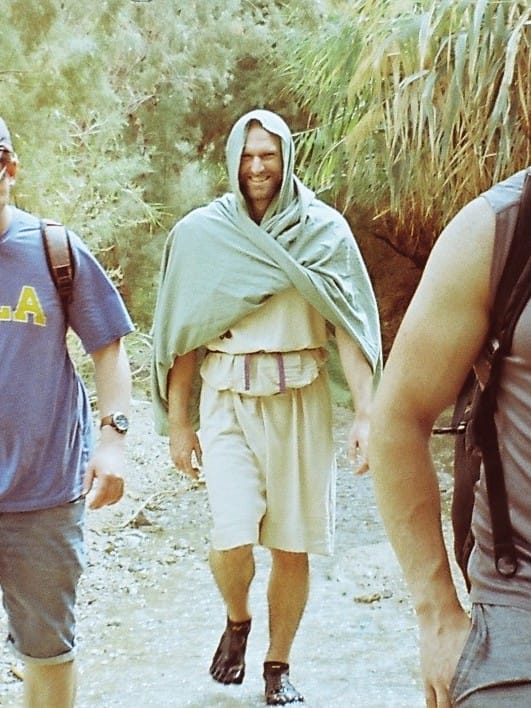
Several years ago, during the isolation of lockdown when we were all attempting to have social lives online, I had the unexpected pleasure of engaging with several Kurdish activists discussing their identity as indigenous people in the Middle East. While Jewish indigeneity to Israel is obvious to anyone who takes time to consider it, I hadn’t spent much time thinking about how other indigenous peoples in the greater Southwest Asia-North Africa region expressed that connection.
My Kurdish friends spoke with pride about their traditional clothing—how they used the colors of their mountains to inspire their designs. On ordinary days, they dressed like most of us: t-shirts, pants, skirts. But for holidays, weddings, and important events, their traditional styles were on full display. This struck me powerfully. Jews have done an incredible job preserving our culture and connection to our homeland. We pray multiple times daily for the return of our exiles to Israel. But how many of us think about Jewish clothing? And if we do, we likely picture Hasidic garb as somehow more authentically Jewish than jeans and a t-shirt.
Realizing we’d lost to memory much of what our traditional clothing looked like started me on a journey of excavating and recreating our ancient dress. What I discovered surprised me: how we dressed both participated in and distinguished us from how the other nations around us dressed at the time. We were visibly Jewish, and that visibility was intentional, commanded, and deeply practical.
What We Actually Wore
The base garment throughout the Ancient Near East was some form of tunic. Ours, like most, typically fell to just below the knee, rising to just above the knee when belted.1 There was variation in hem length and sleeves—the Talmud suggests that sleeve length indicated both the weaver’s skill and the wearer’s social status.2 Evidence points to more respectable garments having sleeves extending to the wrist rather than just the elbow, which was common even among nobility in neighboring cultures. While it is unclear what may have been worn in centuries prior, by the Second Temple era, most people in Israel wore linen as the garment closest to the body, and Beit She’an was famous across the Roman Empire for producing the highest quality linen.3
The outer garment was a long rectangular woolen wrap that Greeks called a himation, Romans called a toga, and we called a tallit or me’il.4 Unlike modern tallitot, ancient versions were much longer and usually less wide. This wasn’t just ceremonial garb as it is today—it was multipurpose. The Torah commands us to return a garment taken as pledge against debt because the borrower might use it as his blanket.5 As someone who has experimented with these wraps, I can confirm: it works remarkably well as a blanket even for someone as tall as myself.
Wool might seem counterintuitive for the Middle Eastern climate, but the fiber’s twist actually provides insulation in both directions—keeping you warm in the cold and protecting your cooler body temperature from significantly warmer air.6 More importantly, while ancients couldn’t dye linen well or permanently, they were extraordinarily skilled at dyeing wool as we see from archeological finds of brilliantly dyed wool fabric fragments.
Here’s what made us visually unmistakable: every tallit worn by a Jewish man had tzitzit on its four corners, with one strand of each dyed with tekhelet—that precious blue-purple dye so valued that it’s likely why Greeks named all Canaanites “Phoenician,” after the Levantine traders who sold them this rare, fade-resistant color.7 That single blue thread on every corner of every Jewish man’s outer garment made us instantly identifiable across the Ancient Near East. While people could probably recognize a Moabite from other cultural signifiers, our distinctiveness was particularly obvious.
Explorations in Experimental Archaeology
Understanding this intellectually is one thing. Wearing it is another entirely.
My first experiment was a workman’s tunic—basic, sleeveless, something that would have been worn for physical labor or even warfare. I made it longer than I initially planned, hemming it below my knees. Then I wore it hiking. The strange looks I got from other hikers were mitigated by the fact that I was clearly normal enough to have friends willing to hike with me, but more importantly, I learned immediately why the hem needed adjustment—having fabric at or below my knees made taking longer strides completely impractical. I raised the hem by several centimeters and was satisfied with both the ease of movement and comfort. This wasn’t arbitrary fashion—this was functional design refined over generations. No wonder this was what men wore to war where they would need to run at full speeds.
Around the same time, I made what I called my “one-day-tallit”—something that would be a proper tallit one day. I wanted freedom to experiment with how to wear a large fabric shawl without the halakhic concerns about tzitzit yet, so my partner in this project rolled up one of the four corners and sewed it down. I’d chosen linen fabric to experiment with, and there were questions about wool tzitzit on linen, plus the additional challenge of sourcing proper linen tzitzit.
What I discovered transformed my understanding entirely. The way I currently wrap is one of many plausible ancient styles, largely depending on how much I needed my arms free for different activities. My one-day-tallit is about two meters long—a bit longer than my wingspan—which provides plenty of fabric to wrap comfortably and stay in place. Much longer would become problematic.
But the revelation was how practical it was. I took it on several hikes and discovered I could easily adjust it for more ventilation and breeze while still keeping the sun off my arms and face. In Israel’s climate, this isn’t a minor consideration—it’s essential. The design wasn’t ceremonial dress that happened to be wearable; it was brilliantly engineered daily wear that was imbued with ritual significance. Since then I’ve made formal Chag and Shabbat robes as well, which I wear often. When someone on the street asked if I wasn’t dreadfully hot, I answered honestly: I was sweating less than in my gym clothes.
Wearing these garments—feeling how the tunic moved when I hiked, discovering the multiple ways to wrap the tallit depending on whether I needed both arms free or wanted maximum sun protection, the swish of my robe around my ankles on Chag—gave me a deeper understanding that no amount of research could provide. I understood viscerally why these designs persisted for over a thousand years.
What We Discovered by Rediscovering
Here’s what struck me most powerfully: We think of our distinctiveness in terms of what we believed, how we practiced, what we ate, how we prayed. While those made us different in fundamental ways, these are invisible markers unless you’re inside someone’s home or synagogue. But in the ancient world, we were visibly Jewish from a distance from the style of our beards to the wrap of our tallitot, and of course, the highly visible brilliantly blue thread on the tzitzit.
That visibility wasn’t accidental. It was commanded. And it was practical—woven into garments that worked brilliantly for the climate and activities of daily life. We weren’t maintaining visibility despite practicality; the visibility was built into practical design.
What we’ve lost isn’t merely a historical curiosity; it’s an embodied identity. My Kurdish friends intuitively grasped something we’ve forgotten in our long exile: indigenous peoples maintain visible cultural markers. They wear their mountains in their clothing on important days. We once wore our distinctiveness every day, and that distinctiveness was beautiful, practical, and unmistakably ours.
The remarkable thing is that this is nearly all recoverable. The designs are relatively simple. The materials are available. The knowledge of how to construct these garments still exists in experimental archaeology and textile history. We can wear this again—not as a costume, but as a reclaimed inheritance.
We’ve preserved so much through exile and persecution. We’ve held onto language, practice, prayer, law, connection to land. Perhaps now that we have returned to our land, it’s time to rediscover what it means to be visibly, proudly, practically Jewish in our daily dress. Not instead of jeans and t-shirts for most days—just as my Kurdish friends do—but for Shabbat, holidays, weddings, moments when we gather as ourselves.
This is ours. It’s been waiting for us to remember.
Dr. Orit Shamir, “Textiles in the land of Israel from the Roman Period till the Early Islamic Period in the Light of the Archeological Finds” 2005
Ibn Ezra on Bereishith 37:3 interprets ketonet passim as a garment with sleeves extending to the palms (pas yada in Aramaic = palm of the hand), indicating that Joseph, unlike his brothers who were shepherds, did not need to perform manual labor. See also Shadal and Rabbenu Bachya, who explain that the length of one’s clothing was a sign of freedom from work and social prominence. Also Bereishith Rabbah 84:8.
Shamir, 2005
Shamir, 2005
Shemoth 22:26-27
Wool fibers’ natural crimp creates air pockets that provide thermal insulation in both directions—trapping warmth in cold while allowing moisture-wicking and breathability in heat.
The Greek word Phoinike (Φοινική) for Phoenicia is linked to phoinix (φοῖνιξ), meaning “purple-red” or “dark red,” referring to the famous Tyrian purple dye the Phoenicians produced from murex shellfish. Historians debate whether the people were named after the dye or vice versa, but the association is clear.