

From Hadesh Vol. 1, Iss. 10 — Purim
By: Hila Oz-Shneider
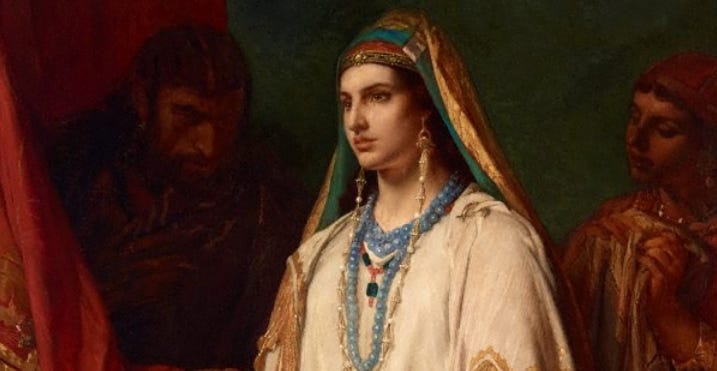
Before I begin this essay, I want to preface that I speak very openly about sexual violence in an attempt not to sugar-coat it. Readers who are sensitive to this topic should be advised.
Purim is known by many as our most fun and festive holiday. Giving gifts of charity, sending food baskets to our friends, dressing up in outrageous costumes, and eating and drinking to our heart’s content and beyond. Even the Megilla reading is full of the excited “boo”s of the enraptured audience any time they hear Haman’s name. On the surface the story seems to be like some fairy tale: the “common” maiden picked to become royalty, palace intrigue, and the ultimate triumph of good over evil, but the story is much grimmer than that. When we look deeper into the text and how Hazal describe Esther’s story, it seems much more like a nightmare than a fairy tale. In light of the recent uncovering of a global pedophilic trafficking ring, I think it very fitting to dive deep into the Megilla and how it describes sexual violence.
The Megilla starts off with gender-based violence in its first chapter, with the attempted coercion into a degrading situation and implied killing–or at the very least, exile–of Vashti. Vashti is an interesting figure in Tanakh, portrayed in the Gemara in one of two ways: evil (from the Bavli) or neutral (from the Yerushalmi).1 Before delving any deeper into the topic, I think it’s important to acknowledge that sexual violence is rarely about sexual gratification; it is almost always about assertion of power.2
According to the Bavli, Ahashverosh may have begun his life as a commoner, a stableboy,3 and was promoted to king partially or mainly due to his marriage to Vashti. In an attempt to assert his power independent from his wife, he calls her to the party to dance naked,4 forcing her to either debase herself publicly, proving her total submission to her husband, or violate a direct order from the king, an action punishable by death. Whether Vashti was killed or deposed, the outcome is the same: Ahashverosh lands on top, and Vashti is left either dead or destitute.
Regardless of Vashti’s personal morality, she was a victim in this sense. The Gemara tells us that what made her wicked was not only her halting the rebuilding of the Bet HaMikdash,5 but also that she would force Jewish maidservants to perform melakha naked on Shabbat. If we go by the Bavli’s opinion here, we understand that in societies whose values are not based in Torah, but rather in aesthetics, gluttony, and hedonism–as described in Ahashverosh’s first party–sexual violence is the obvious outcome.
“The Megilla purposely portrays the promiscuous, orgiastic, sex-crazy life of Persian upper society… They had lost all standards of decency; the woman turned into a female animal. She had nothing in her life but the gratification of the desires of the opposite sex.”6
This degeneracy was so deeply ingrained into the Persian psyche that even women were willing to contribute to the degradation of their own sex in an attempt to feel some level of power in a world where they had little to none. These Jewish hostages were robbed of their dignity and ability to perform what they deemed most holy, and for that the Sages declare that Vashti received measure for measure: she was killed on Shabbat for refusing to show up naked against her will. The chapter ends with a decree that seems almost ridiculous in how superfluous it is in the society described so far, that “each man be master in his home, speaking the language of his own people.”7
The Megilla continues to describe a global pedophilic trafficking scheme in an attempt to please Ahashverosh. The Malbim brings down that the punishment for non-compliance with the decree to have these girls taken by force was the death penalty.8 In her research, Tamar Eilam Gindin points out that the common age of brides in Persia during that time was around nine at the oldest.9 Of course some commentaries bring down that Esther was 40 or even older at the time of her kidnapping,10 but regardless of Esther’s exact age, we know that the vast majority of girls kidnapped in order to be raped by the king were around/under nine, as it was explicitly decreed to round up virgins.11 While I think there is what to say about approaching this within its historical context, the fact that this type of abuse was so widespread and accepted does not erase the damage caused to the victims (in the same way one may discuss ancient near-eastern slavery).
After these girls were rounded up, they went through a year-long beauty treatment, which served as a time for Hegai (the eunuch in charge of the virgins) to essentially groom these girls into complete obedience via their constant dependence on him.12 After Vashti’s public defiance of the king, measures were put in place to ensure the issue would not be repeated with the new girls. The girls were also granted anything they requested for their night with the king, which could be viewed as a way to manufacture consent from those who would otherwise be completely unwilling.
Just imagine: you’re a peasant girl from a poor family, stolen away from the only life you’ve known to fulfill the king’s desires. You know if you are not chosen as queen or do not conceive after that first night, you will likely spend the rest of your life as a prisoner of the palace. At the same time, not only are you awed by the grandeur of the palace, the access to clothes and cosmetics you could never dream of, but you are also competing for a chance at a better life. This forces you into the uncomfortable situation of having to seem like a willing participant in your own abuse.
After their night with the king, the girls would be sent to the house of concubines never to be seen again unless called by name.13 For the rest of their lives, they would be forbidden to any other man, unable to return home, and chained to Ahashverosh whether or not they ever saw him again.
As previously mentioned, Esther may or may not have been around the age of nine at the time of her abduction. If she was, I have already touched upon the grave injustice committed against these children. If she was not, she was still kidnapped and raped many times over the course of her life.
The Megilla speaks about how she requested nothing from the palace,14 completely refusing to even hint at consent. Rav Noble goes on to say, “despite her beautiful appearance fading as a result of becoming green at the thought of pleasing a wicked person, she requested nothing to address this issue, which shows the degree to which she had to be forced to marry Ahashverosh.”15
When speaking about Esther’s relationship to Ahashverosh, the Gemara says that she was קרקע עולם, like the everlasting ground.16 There are some who expound upon this to say that it simply meant she wasn’t an active participant,17 but to many others, the wording is much more tragic. It not only speaks to an unwillingness to be intimate but to a deep traumatic response. To be like the ground, like the earth, involves a self-nullification. She is not there, she is not living at that moment. Many survivors of sexual assault have experienced a similar feeling.18 When being violated, they want to sink into and become the earth. Their agency is stolen and so it is as if they are inanimate.
The Zohar expounds upon this phrase saying that whenever Ahashverosh called, Esther sent a demoness to take her place.19 The Kabbalistic implications of this statement, as well as the Jewish view on demons (that they are not necessarily evil, i.e., if a demoness took Esther’s place, it would actually be good), are beyond the scope of this essay, but the demon could be interpreted as Esther having an out of body experience at the time of her assault. This is yet another trauma response that many survivors of sexual violence experience.
We know that the only time it could be argued that Esther was an active participant in her “relationship” with Ahashverosh is when she goes to plead for him to cancel Haman’s genocidal decree, and even that is under duress. Shortly before this, she mentioned that she had not been called to Ahashverosh in the past thirty days,20 implying that this was either an abnormally long time to not be called or that she was likely to be called soon. Keep in mind: this was about five years into her being queen,21 and she remained queen until well after the Megilla ended.22 One can only imagine the amount of abuse she faced in her life.
When we hear the Megilla we rejoice at the happy ending wherein the Jews overcome their foes, but this happiness and success is at the expense of the book’s titular figure. Many scholars, rabbis, and sages speak highly of Esther’s level of sacrifice. Through her pain and suffering, the Jewish people were saved. It is beautiful and natural for Jews to find the good in what seems irredeemably evil, but when we pass off her suffering as simply “for the cause,” and are satisfied with the catharsis felt after hearing the story, we miss a deeper meaning.
There is much to be said about how sexual violence is handled within the observant Jewish community, but the issue is so much broader. Jews were chosen to be a “kingdom of priests and a holy nation.”23 The job of a priest is to facilitate connection between man and G-d, and if all the Jews are members of this kingdom of priests, then it is clear that we are meant to facilitate that relationship for all of the non-Jews of the world. It seems to me that we are exposed to this level of degeneracy and violence in the Megilla because we are meant to do something about it.
When there is an obsession with aesthetics and carnal pleasures, those in power are able to easily disregard the personhood of others, which leads not only to widespread sexual violence, but ultimately to genocide. How are we as a community fighting against this toxicity? What are we saying about the status of women in Iran outside of our own national interests in toppling the regime? How are we speaking out against the prevalence of child marriage in Afghanistan and the fact that women are not allowed any agency in their life? What are we doing to counter the culture that tells women it is empowering to engage in sex work–an industry built off of pedophilia, rape, and human trafficking?
It’s nice to speak about Esther as being this strong, courageous heroine. Perhaps Hazal, in saying she was 40 (בינה) or 80 (double בינה), was attempting to acknowledge her resilience in the face of unspeakable abuse, but the events of the Megilla and the words of Hazal are meant to elicit an emotional response within us. We are meant to be angry at the injustice of it all. We are meant to be called to the fight for morality.
And therein lies the essence of the holiday. In a story which portrays the evils of a society which values physicality over all else, we are called upon not to abstain from physical pleasure, but to engage in and uplift it. There is holiness in eating. There is holiness in drinking. There is holiness in aesthetics. There is holiness in intimacy. We have been chosen to show the nations how to be holy in this world, both by destroying evil and uplifting good.
The Yerushalmi does not engage in long aggadic expansions of the text as the Bavli does, so there is no mention of Vashti in the Yerushalmi.
Diana Scully, Understanding Sexual Violence: A Study of Convicted Rapists (Boston: Unwin Hyman, 1990).
TB Megilla 12b
Ibid.
Me’am Lo’ez Esther 1:1. She was the great-granddaughter of Nebuchadnezzar, and therefore opposed the rebuilding of what he destroyed.
Megillat Esther Mesorat HaRav, p. 70
Esther 1:22
Malbim Esther, commentary on Esther 2:9
Tamar Eilam Gindin, “בת כמה הייתה אסתר כאשר נלקחה לאחשוורוש,” Facebook video, n.d., accessed February 17, 2026, https://www.facebook.com/reel/489900970645968
Josippon
Esther 2:2
Malbim Esther, commentary on Esther 2:2-3
Ibn Ezra on Esther 2:14
Esther 2:15
The Vilna Gaon on Megillas Esther, commentary on Esther 2:15
TB Sanhedrin 74b
Rashi, ad loc.
Gershen Kaufman, The Psychology of Shame: Theory and Treatment of Shame‑Based Syndromes (New York: Springer Publishing, 1996).
Zohar III, 276a
Esther 4:11
Esther was chosen as queen in the 7th year of Ahashverosh’s reign (2:16), and the main events occur in the twelfth year of his reign (3:7).
Ahashverosh reigned 14 years (TB Megilla 11b), and Darius, Esther’s son, was king for 35 years, according to the standard text of Seder Olam Rabbah.
Exodus 19:6