

From Hadesh Vol. 1, Issue No. 7 - Clothing
By: Rabbi Isaac Ludmir
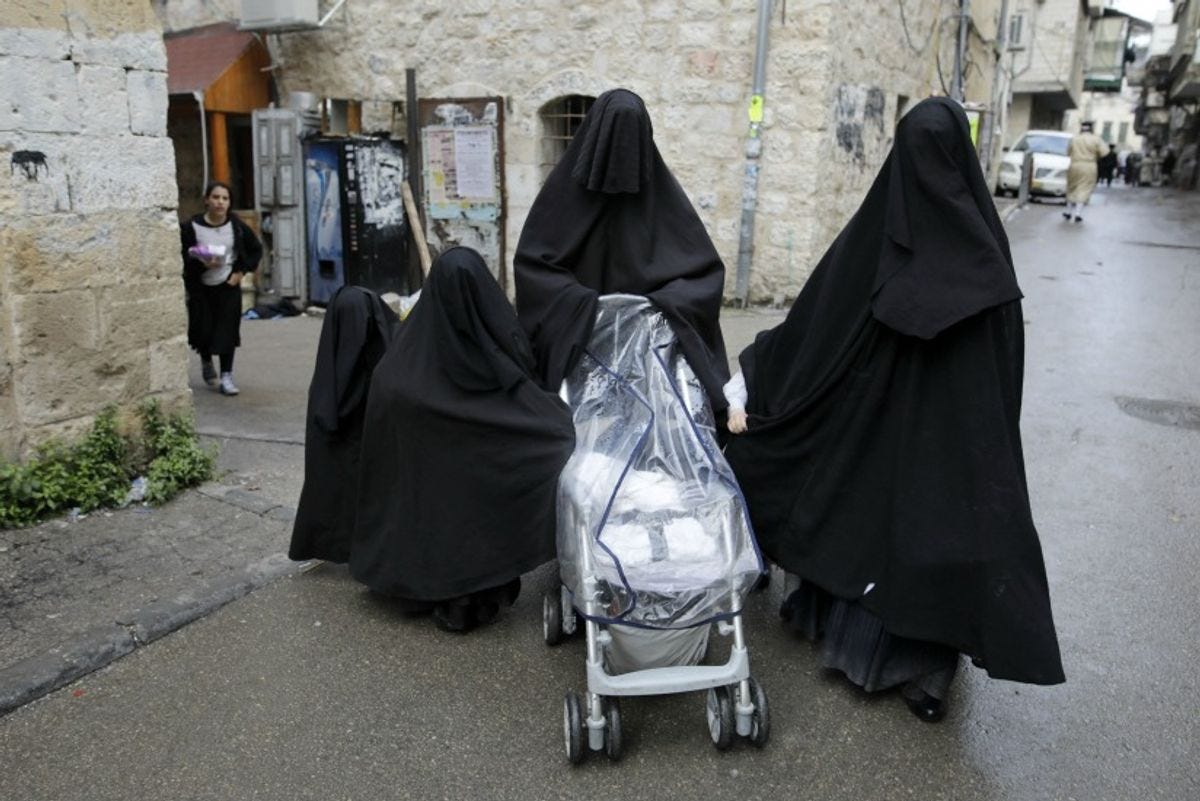
One of the most shameful sights of my lifetime (and I have seen quite a few) was the Haredi “Assembly for the Torah Students”. True to the biblical maxim that “from the wicked, wickedness shall come”1, it has supplied us with an inception-like kaleidoscopic shame. Everything from the disruption of the life of Israel’s capital, the deliberate clogging and obstruction of public transit, to the death of a 15-year-old boy.2
However, the most notable was that of a female reporter who covered the event. Now, journalistic coverage of protests is par for the course. As a matter of fact, coverage is largely seen as a positive in the eyes of the protestors since they help the protest come to public consciousness. Nevertheless, the reporter had been pelted with rocks, water bottles and other assorted projectiles and was chased by the (all-male) protestors, as reported even in sympathetic sources.3 Later, Haredi advocates attempted to excuse the inexcusable by arguing that she was “dressed immodestly” and that the crowd was provoked.4
Beyond the fact that this is monstrously unhalakhic (the Torah did not, in fact, institute a sentence of stoning or a permission to injure a Jewess over her wardrobe), and that Haredi behavior at prior events suggests this is a general pattern of behavior towards women, regardless of their religious affiliation and dress5 - it opens up a fascinating topic for us: namely the concept of צניעות, as it is understood today. Specifically, the control of dress of (mostly female) Jews.
False Accusations and False Sins
First, let us get one thing out of the way. The female reporter was not dressed “provocatively” by the standard of general Israeli society. She wore professional, climate-appropriate attire consisting of a simple, unadorned, opaque white shirt covering her entire torso and upper arms and a pair of simple, long, grey pants covering her ankles. This is the kind of attire Haredim encounter every day in Jerusalem (and indeed, in every city which has both Haredi and Hiloni populations). It’s suitable for walking and working (unlike the protesters’ jackets and fedoras) and cannot be construed by any reasonable person as conveying sexual availability or looseness.
The distinction is important since the Torah does not contain any commandment for women – or anyone! – to be dressed in a particular way, or indeed, at all.
The Interaction of Cultural and Divine Nomoi
The closest thing we have in ancient sources to הלכות צניעות – specific rules which govern female dress on the ground of their sexual provocativeness – is דת יהודית, that is, the common custom of Jewish women in a particular time and place. The Yerushalmi makes it clear that Kephaltyn (a hair net, from the Greek “Κέφαλος”, “Head”) which the Bavli6 calls קלתה שבראשה (“Her head-basket”, Rashi’s strange interpretation of it being a literal basket is tendentious) was undergoing a process of moving from being a necessary head covering for respectable women in public places to being also being required in the semiprivate settings of the common courtyard (it is important to note that in those courtyards, neighbors would mingle, thus the woman would be seen wearing her Kephaltyn by her male neighbors).
The word Kephaltyn is unrelated to the Latin “capillitium” “hair” and does not mean “a wig”. Such an explanation is supported neither by careful analysis of Tanaitic/Talmudic Hebrew (which had a native term for a wig) nor by archaeology (which shows Jewish women depicted as wearing hairnets since the 8th century BC Judean Pillar Figurines, which are of course idolatrous items, but were produced by local artisans and are modeled after local women), nor by the socio-economic analysis of the period (Roman wigs were the luxury item par excellence, the idea that every Jewish woman could afford one and then never wore it beyond the courtyard is absurd on its face) nor by the comparison of the Yerushalmi and the Bavli (the former is using a Greek term since Koine was widely used in 3rd century Galilee, the latter is grasping for the closest Hebrew term it could find – and “hairnet” is much closer to “basket on her head” than “wig”).
At any rate, not only is the vaunted דת יהודית a culture dependent rather than eternal standard,7 it is not a spiritual command. If Jewish women had a commandment to dress decently, יוצאת וראשה פרוע would have been in the עוברת על דת משה category. Rather, immodest clothing would’ve been considered a grievance against her husband since, throughout most of human history, a husband’s honor was tied to the decent public conduct of his wife. Indecent custom constitutes a deliberate humiliation of one spouse by the other, who cannot be reasonably expected לדור עם נחש בכפיפה אחת – i.e. to tolerate deliberate, unending psychological abuse.
The Non-Halachic Nature of Haredism
Haredism, however, is strictly un-halakhic in its outlook. It had inherited a nexus of semi-mystical, semi-pietist and mostly neurotic obsession of “tzniut” as the quintessential – indeed the only- spiritual outlet for women, “equivalent to the Torah study of men”. This is not merely an ahistoric, despiritualizing, and condescending approach, it is simply extrahalakhic in the worst sense of the word. It revokes the true function of modesty in the Halakhic mind and turns it into an idol in whose name women who fail to uphold the Beis Yaakov fabrication are fair game for violence and humiliation (and yes, perverse lust).
Let us now declare openly: These men are not the practitioners of our King’s Law, they obey not His statutes, and keep not His commandments. They have removed themselves from the Lord’s congregation, and we should likewise remove ourselves from them:
ס֣וּרוּ נָ֡א מֵעַל֩ אָהֳלֵ֨י הָאֲנָשִׁ֤ים הָֽרְשָׁעִים֙ הָאֵ֔לֶּה וְאַֽל־תִּגְּע֖וּ בְּכָל־אֲשֶׁ֣ר לָהֶ֑ם פֶּן־תִּסָּפ֖וּ בְּכָל־חַטֹּאתָֽם
I, for one, am not afraid of sounding “mystical”. I truly believe and fear the judgment of our Eternal Lord, but there is another point. If National Orthodoxy does not give Haredism a clear and clean cut divorce, it would be in danger of drifting into radicalization due to the Haredi illusion of authentic fidelity to the Torah, thus losing not only the national ideal, but the actual practice of genuine Halachah.
1 Samuel 24:13
It seems the boy was in one of those dark episodes of youth which might cause a teenager to take extreme action. However, this does not absolve the organizers who did nothing to assure the safety of the “assembly” and who are solely responsible for him having the opportunity.
www.kikar.co.il/haredim/t4y7nl
https://x.com/menishwartz/status/1983937218637938788
https://www.maariv.co.il/news/politics/Article-1122654
Yerushalmi Ketubot 7:6, Bavli Ketubot 72a-b. The Beraita which is brought up in Ketubot derives a prohibition on married women to go out with “unkempt hair” (יוצאת וראשה פרוע) from Numbers 5:18, but the gemara makes it clear that this demand, whether or not an actual Mitzvah or merely a recorded pre-mosaic norm, is satisfied even by the common hairnet.
This understanding permeates Halachah to this day: If a Hiloni husband attempted, for instance, to divorce his Hiloni wife without the benefit of Ketubah on the grounds that she wears a bikini to a mixed-beach, he would be laughed out of court. A Dati husband would be taken more seriously. See Igrot Moshe, Even HaEzer A:114, Yabi’a Omer Even HaEzer 3:21